I converted these videos to a .mov file so that imovie was able to use the footage. I used Wondershare video downloader to download it as a .mov file. I helped my partner with the script a little bit but he mainly refused help from me. He said that I will be doing all the editing and narrating and he will be doing the planning.
Tuesday, May 31, 2011

Tuesday, May 24, 2011
ICT - Documentary Script
Documentary
First: Narration about the every day conditions in Darfur (dust storms, water etc.)
Overall image: Government oppressing the south.There is a religious conflicts between Christians and Muslims. South has started a rebellion to become independent. Refugees flee to Chad. Government use Janjaweed to fight against the rebels.
Second: Opening (title, fitting music)
Third: Start narration on Janjaweed
Information about Janjaweed:
1. The name Janjaweed comes from Arabic. The most common translation of this name is “Devils on Horseback’
2. In the past the Janjaweed used to be nomadic tribes. They weren’t aggressive, and were only involved in skirmishes with the non-nomadic population of Darfur. These skirmishes grew in number as the amount of water and rainfall dwindled and as there no longer was enough space to provide for both natural grazing grounds for the nomads and for farmland for the villagers. But even though these skirmishes grew a bit in number, they were nothing compared to what the Janjaweed are doing now.
3. Nowadays the Janjaweed are armed militiamen in Darfur. They consist primarily out of Arab tribes. Since the 2003 revolution they are very aggressive as the government unofficially uses them to fight the rebels.
4. This revolution, started by the Sudan Liberation Movement (original name: Darfur Liberation Front) and the Justice and Equality Movement, has as goal to improve the living conditions for the non-Arabic and poor people of Sudan and primarily Darfur.
5. During this war they have committed dozens of crimes and violations to the Human Rights. These include burning villages, raping woman and committing mass genocide against the non-Arabic people of Darfur
6. Because of these atrocities, since 2003 2 million people have been forced to relocate inside Sudan and thousands of villages have been destroyed or severely damaged. Burned and sometimes still smoking villages are a common sight in Darfur. (Google Earth and video clip footage)The war has gone so far that it has spread over the border into Chad. Currently there are over 250,000 Darfur refugees in Chad refugee camps. The Janjaweed atrocities don’t stop at the border either. The Janjaweed regularly cross the border to attack and destroy refugee camps and even villages in Chad, displacing over 170,000 Chadians.
7. The Janjaweed also recruit child soldiers. These kids usually come from Sudanese refugee camps. They are not the only ones. The Sudan People’s Liberation Army (SPLA) and the other rebel groups have also recruited child soldiers, however, the SPLA has acknowledged the fact and has made efforts to stop the recruitment/deployment of child soldiers.
8. The Janjaweed are ordered to do all this by the government. The government provides the weapons, gives the orders and acts innocent. They support the Janjaweed, using them against the rebellion. They support the militia by providing weapons, safe training camps and other utilities. Their support sometimes goes as far as delivering direct air support for the militia. (show BBC interviews with the Janjaweed defector). The UN and the Human Rights Watch have confirmed this support.
9. (APC footage) The UN and the UN Security Council have made several attempts at getting the Sudanese government to stop supporting and start disarming the militia. These attempts have been to no avail. The Sudanese government is effectively frustrating the UN by not cooperating and counteracting the measurements taken. The government still denies any link to the militia, but continues to provide the UN forces with difficulties and excuses. The conflict has reached a stalemate, as in that the UN can't do anything and Sudan doesn't want to do anything. The UN has stationed a small peacekeeping force on the border with Chad, but the force is way too small to protect all camps. The fighting will continue with no end in sight. The Red Cross (flash to compound footage) and other humanitarian aid organizations try to help the victims of the violence, but this is made difficult as danger risk is just too high.
Tuesday, May 3, 2011
ICT/Media - Janjaweed notes
Janjaweed Notes
- Funded by government to kill people at Darfur
- Killed men and raped women in Darfur
- Multiple crimes to humanity (rape, killing, etc...)
- Should be counted as genocide. By 2007, estimates were that 200,000-400,000 people were killed in the genocide.
- Only African union sent troops but only 7000 to counter-act the Janjaweed. The UN has attempted several times to get the Sudanese government to disarm the Janjaweed.
- Two rebel groups, Justice and Equality Movement (J.E.M.) and the Sudan Liberation Army (S.L.A.). They are fighting for freedom and improvement of the conditions in Darfur. The government uses the Janjaweed to fight back.
- Government call it Ethnic cleansing
- Sudan ignoring what is happening in Darfur
- The leader of Janjaweed is Musa Hilal
- Name Janjaweed is arabic for Devils on horseback
- Name Janjaweed is arabic for Devils on horseback
Tuesday, April 12, 2011
ICT/Media Documentary Notes
Sudan documentary 1
-Small clips
-Pictures
-Some text
-Background music (the country’s style music)
-Narrator (cannot see)
-Pictures/small clips are relevant to what the narrator is saying
-Focus on peoples eyes for more emotion
-Quoting
-Background information
Sudan documentary 2
-Different pictures/video clips shown at once
-Narrated by a native
-Start with background information
-Questions
-Constantly showing the word Sudan
-Music
Inside Job trailer
-Lots of clips
-Overlapping of clips/pictures
-Multiple languages
-Interviewing people
-Music
-Quotes
All these documentary's have something in common, they both have a narrator talking about it; the narrator is not visible, they all use short clips instead of long ones, they always talk about the background information (e.g. if they are talking about a country then they will start off with where the country is, who lives there, etc...), they all in a way made the viewer closer to make it a bit more emotional like focusing the camera on the eyes of the people in the documentary and they all have music.
Tuesday, April 5, 2011
Media - Sudan video reviews
http://www.youtube.com/watch?v=USLDoIiFzzg
I watched this and I thought this was a good video because it explains in detail about the war, how it started and the people suffering when this happened.
http://www.youtube.com/watch?v=reUqSTZlgY8
This video is about two girls who have something in common, they both had parents and saw them get killed.
http://www.youtube.com/watch?v=ymlDzExwMQw&feature=relmfu
This video talks about the aftermath of the conflict and how people in Sudan are still suffering.
I watched this and I thought this was a good video because it explains in detail about the war, how it started and the people suffering when this happened.
http://www.youtube.com/watch?v=reUqSTZlgY8
This video is about two girls who have something in common, they both had parents and saw them get killed.
http://www.youtube.com/watch?v=ymlDzExwMQw&feature=relmfu
This video talks about the aftermath of the conflict and how people in Sudan are still suffering.
Media - Sudan video reviews
While watching the different youtube video’s about Sudan, I noticed that none of them really had anyone smiling. Most of the people were doing things like fighting for water or getting water out of the drains, there were some who were TRYING to smile but when I saw them I knew they were really sad on the inside.
Another thing I noticed about the people were that they were based on the most badly affected places such as Darfur.
Science - My genetics game review
My genetics game is basically a questionnaire. It has several questions with multiple choice answers and each answer tells you to go on a page. If you are able to answer most of the questions right then you can go through it quicker but if you answer most of the questions wrong then you would have to take longer to answer.
In the game, I made sure the questions were not too easy but also not too hard so it could be possible to answer. The gameplay however was a bit boring because it was only answering questions (but for some reason some people found it interesting, they were probably being sarcastic). My original intention was to add these bonus's and disadvantages to the wrong and right answers to make the game more interesting but I decided to get rid of that idea because of the fact that it got too confusing that I almost was not able to understand it myself. I did it on a powerpoint (Weirdly, no-one else's uses a computer to play) because I thought that it would be easier to make than a board game but I was wrong, when it came to placing the questions on different pages I was a bit stuck because It was a bit hard to add the right and wrong answers on without actually giving it away like the first one (The first three were wrong and the last one was right).
As a conclusion, I thought that I can improve it to make the game more interactive because the purpose of this was to make a way of learning this without it being reading of a textbook or doing questions and I did not do that. Another improvement I should make is to have more questions because I only had three questions in the questionnaire (if you got them all right) and that isn't much to help learn. One final improvement is to make it more complex because if I had four answers for a questions and they lead to a page (e.g. pg 5,6,7,8), I sometimes just mix up the numbers (e.g. 6, 8, 5, 7) and people can still easily see the answer.
Sunday, April 3, 2011
Science - Genetics games review
When I was playing with the genetics games, I only got to play Lewis's one and Maddy's one.
Maddy:
I think Maddy's game was good. There were many good questions (there were also some I didn't know), the actual gameplay was fun and it was not really complicated. A few problems with it was that there are some parts that send you way back or send you close to the finish line too easily, at the start there was a yellow box that asks you to move to the next yellow box and the next yellow box said move 15 steps. Doing that will basically make the player answer less questions so they won't learn as much.
Lewis:
Lewis's game was simple but good. It was a bit like monopoly, it had some cards, a board and on the boards there were steps with a question mark, L or T, normal spaces and a space where you skip 2 turns. There were many interesting questions and the gameplay was not as fun as Maddy's one but it was still good. I didn't really see many flaws with the game except for the L or T spaces (stands for luck or trouble). Sometimes you get L or T that moves you forward but then you go to another L or T and you have to move back again.
As a conclusion, I prefered Maddy's one because it was a lot more fun and I thought the question was a lot more challenging.
Maddy:
I think Maddy's game was good. There were many good questions (there were also some I didn't know), the actual gameplay was fun and it was not really complicated. A few problems with it was that there are some parts that send you way back or send you close to the finish line too easily, at the start there was a yellow box that asks you to move to the next yellow box and the next yellow box said move 15 steps. Doing that will basically make the player answer less questions so they won't learn as much.
Lewis:
Lewis's game was simple but good. It was a bit like monopoly, it had some cards, a board and on the boards there were steps with a question mark, L or T, normal spaces and a space where you skip 2 turns. There were many interesting questions and the gameplay was not as fun as Maddy's one but it was still good. I didn't really see many flaws with the game except for the L or T spaces (stands for luck or trouble). Sometimes you get L or T that moves you forward but then you go to another L or T and you have to move back again.
As a conclusion, I prefered Maddy's one because it was a lot more fun and I thought the question was a lot more challenging.
Thursday, March 31, 2011
ICT - Computer Essay Final Version
This essay is going to be about the computer system, mainly on the four layer model: hardware, software, network and people.
Hardware:
The hardware is the physical part of the computer like the case and the hard drive. The computer can work without some of the hardware such as the case but will not be as effective because if you turn on the computer, without the fan it could overheat. It is the same with the hard drive, if you don't have one then the computer won't function at all. The main hardware in the computer are the motherboard, the CPU, the RAM, the hard drive, the optical disc drive, the power supply and the case.
The motherboard is where all the wires from all the components are connected. It looks very complicated with all the small dots and lines as shown on the bottom. The motherboard can't actually tell what it wants all the hardware to do so it would need some other component to tell everything else what to do. That component is the CPU
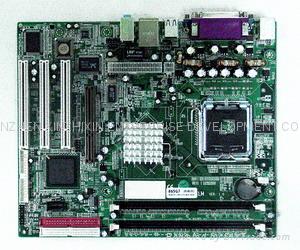
The CPU is a small computer chip that is put into the motherboard. The CPU is basically like the “brain” of all the hardware inside the case, without the CPU the the computer won’t function at all because there would be nothing to tell everything what to do. Even though the CPU is the brain of it all, it can't store any memory. Where does all this memory go? It goes to the RAM and the hard drive.

The RAM is very good at saving memory on your computer and also allows your computer to work faster. The RAM makes your computer to work faster because each program in the computer requires a specific amount of the RAM for it to work, therefore the more RAM there is, the more smoothly it will run. Even though it is good at saving memory, it is only temporary so if your RAM wasn't able to save it yet and your computer turns off then none of the memory would save. Now the question is: How does your computer store memory for a longer period of time? The answer is the hard drive.

The hard drive has a lot more memory than the RAM but it is a lot slower. When turning off the computer, the RAM would be in the process of transferring its data into the hard drive. Without the RAM then the computer would be slow but without the hard drive the computer can't save things permanently. There are also portable hard drives where you connect them with a USB cable (it basically acts like a thumb drive but can store up a lot more memory). There are also discs to store memory in but the disc would have to go somewhere. That somewhere is the optical disc drive (ODD).

Normal Hard Drive

Portable Hard Drive
The Optical Disc Drive is where you put the CD’s, DVD’s and other disks in. The information from the disk is transferred into the computer. All of the hardware would need a power source for it all to function, the hardware gets all its power from the power supply.
The Power supply is to make sure the computer has power to operate. It has a wire that you need to attach to the power supply and a socket. With laptops, there is a charger to recharge the battery of the laptop.
That just leaves us with one final question, where does all these components go? The answer is the case.
The case is just simply the part that covers all the electrical parts inside, the case includes the fan. The fan is used to make sure the computer on the inside does not overheat.
Software:
The software is the part of the computer in the operating system (OS) such as Windows, Mac and Linux.

Applications on the computer like games and Microsoft word are included with the operating system. Without the software's then you wouldn’t be able to do anything with the computer. Some examples of software are Microsoft Office (Word, Excel, etc…), games and Internet browsers (Firefox, Rockmelt, etc…).


Network:
The network is a connection between different computers. The Internet is described as “a networks of networks” because it is a network filled with many other networks. When someone sends files through the Internet, it is sent in these things called “packets”. For example, if you send a picture then the picture will be split up into different packets and each packet will go different ways, the packets will go the fastest way and if there is some sort of obstruction then the packets will find a different route. It will then go to the person who wants to look at the picture.
When we go onto different websites, we use domain names to go to that website (e.g. Google.com). But computers don't recognize websites by its domain name, it recognize websites by IP addresses
(e.g.
The terminal is a application where you can type in codes and others to make it do certain actions such as looking for the IP address of a website/your computer and allowing you to change a few bits and pieces on your computer. To look for the IP address of google as an example, just type:
ping google.com
After you done that, this IP address should show up:
64 bytes from 74.125.71.99: icmp_seq=0 ttl=55 time=17.036 ms
The computer will go to the website and "ask" for the IP address and google would respond and upload the IP address to the computer. You can see a picture below as an example.


People
People that use technology use it in a good and bad way. Some people just use computers to play games, do work and talk to people over the Internet. However, there are people you use it in a bad way like hacking into other peoples computers, taking their information and using that information in a bad way like pretending to be another person. Using computers in a bad way doesn't only mean things like hacking and stealing information though, it is sometimes about pollution. People make a lot of waste when using ICT like this. When they are done using ICT, they simply throw it out and the battery in Ipods and laptops are toxic. Fortunately there are companies such as Apple that have recycling programs for the computers and other technologies where they use the old computers and other technology as spare parts.
There are cases where you would be using it in a bad way and a good way simultaneously. One of them is if you use the computer to do work such as teaching or business, you would still be destroying the environment because it drains electricity.
Online communities on the Internet affect people in various ways. Some people develop addictions to the computer and starts using it a lot, taking away their social skills. Those people with addictions won’t be able to live through life because they don’t have the social skills to talk with the people properly. For example, the Youtube videos “Greatest Freakout ever” is based off the cameraman’s brother who is addicted to videogames was enraged when his mom stopped his World of Warcraft account and because of this he has problems when he goes outside because people would make fun of him.
Tuesday, March 22, 2011
Spanish dialogue - Shopping
Yo: ¡Hola!
Casper: ¡Hola!
Yo: ¿Comó estas?
Casper: bien, gracias. ¿Y tu?
Yo: Bien. ¿Adonde vas?
Casper: voy a centro commercial.
Yo: ¿porque?
Casper: Porque yo quiero la ropa Nuevo.
Yo: ah si, yo tambien
Casper: Hasta luego
Yo: Hasta Luego
MAS TARDE
Yo: Casper
Casper: Ah, hola
Yo: ¿Que quieres?
Casper: hmmmmm, yo no se. Me gusta la camiseta y los vaqueros, pero el centro commercial tienes muchas tiendas de ropas.
Yo: hmmm…. ¡ah! Yo sé una tienda de ropa.
Casper: si
IR A LA TIENDA
Casper: ¡La tienda es muy grande!
Yo: Yo sé
Casper: ¡Vamos a la tienda!
Yo: No, voy a tienda diferente
Casper: Si, gracias. ¡Hasta Luego!
Yo: ¡Hasta Luego!
MAS TARDE
Casper: ¡Johnathan!
Yo: Ah, hola Casper
Casper: ¡Gracias por muestras me!
Yo: de nada
Casper: ¿Que Compras?
Yo: fui a comprar una camisa, unos pantalones y unos zapatillos de deporte.
Casper: ¿Cuánto cuesta?
Yo: Cuesta dos cientos dolares. ¿y tú?
Casper: Cuesta cincuenta dolares.
Yo: ¡Sus ropas son muchas baratas!
Casper: ¡No, sus ropas son muchos caros!
Yo: ¡No!
Casper: ¡NO!
Yo: Sigh... no importa. Adios.
Casper: Sigh... Adios.
Casper: ¡Hola!
Yo: ¿Comó estas?
Casper: bien, gracias. ¿Y tu?
Yo: Bien. ¿Adonde vas?
Casper: voy a centro commercial.
Yo: ¿porque?
Casper: Porque yo quiero la ropa Nuevo.
Yo: ah si, yo tambien
Casper: Hasta luego
Yo: Hasta Luego
MAS TARDE
Yo: Casper
Casper: Ah, hola
Yo: ¿Que quieres?
Casper: hmmmmm, yo no se. Me gusta la camiseta y los vaqueros, pero el centro commercial tienes muchas tiendas de ropas.
Yo: hmmm…. ¡ah! Yo sé una tienda de ropa.
Casper: si
IR A LA TIENDA
Casper: ¡La tienda es muy grande!
Yo: Yo sé
Casper: ¡Vamos a la tienda!
Yo: No, voy a tienda diferente
Casper: Si, gracias. ¡Hasta Luego!
Yo: ¡Hasta Luego!
MAS TARDE
Casper: ¡Johnathan!
Yo: Ah, hola Casper
Casper: ¡Gracias por muestras me!
Yo: de nada
Casper: ¿Que Compras?
Yo: fui a comprar una camisa, unos pantalones y unos zapatillos de deporte.
Casper: ¿Cuánto cuesta?
Yo: Cuesta dos cientos dolares. ¿y tú?
Casper: Cuesta cincuenta dolares.
Yo: ¡Sus ropas son muchas baratas!
Casper: ¡No, sus ropas son muchos caros!
Yo: ¡No!
Casper: ¡NO!
Yo: Sigh... no importa. Adios.
Casper: Sigh... Adios.
Subscribe to:
Posts (Atom)